EV’s Should you consider buying one?

Electric vehicles or EV’s are the future of mobility, and have a huge role to play, when it comes to eco-friendly transportation. 

What are EV’s?

In an Electric Vehicle (EV) the electric motor runs by utilising the electricity stored in its battery. Here the electric motor does everything an internal combustion engine in a gas-powered car does. The battery of the EV is charged from time to time.

How EV’s work?

EV’s produce their maximum torque output straight out of the bat. That means you have access to the entire torque output straight from standstill. It only starts decreasing as you progress towards the upper RPM range due to the phenomena of back EMF. EV’s only consist of one intermediate part between the wheels and the motor, the transmission. Hence, they produce a really high torque output and experience negligible output loss at the same time.

Smooth Driving Experience

EV’s don’t have a lot of moving parts inside the engine. In fact, they only have one moving part, which is the electric motor. The petrol engine has a myriad of rotating parts inside. In order to produce power, they have to constantly keep grinding and hitting against each other. The sound waves created from the contact between these parts is heard as the exhaust note and felt inside the car’s cabin as vibrations.

While nowadays, petrol engines release significantly lesser noise and vibrations compared to what they would a 7 or 8 years ago, they still exert noticeable levels of both.  In an electric vehicle, the only moving part is the motor which spins and in turn rotates the wheels. The only sound that can be heard from this process is a very futuristic and almost silent whine. The same attribute also contributes to an absolutely vibration-free driving experience as well.

Points to be considered before buying an EV

Now that you had decided to buy an EV there are few things to be kept in mind before buying one

Budget

This is the most important point we Indian’s consider while buying a new car. EV’s are eco friendly but aren’t pocket friendly. An EV can cost you ₹ 5-6 lakhs more than their ICE(petrol/diesel) counterparts

Vehicle Specifications

EV’s come with range of power and battery pack options you will have to choose one based on your requirements.

Tax Benefits

Government has taken steps to encourage the use of electric vehicles by granting reductions on motor taxes. Likewise, by providing subsidies and other incentives on EVs the government is trying to promoting sustainability.

Battery

Battery pack is the heart of an EV. Battery is the most expensive part of an EV, replacing one can burn a hole in your pocket. So, always check the battery life before investing in an eco-friendly car. The longer the battery life, the lower the maintenance cost. Recently Hyundai recalled it’s Kona EV over faulty battery pack. Most of car manufacturers give 8-10 years of warranty on battery pack.

Driving Range

Driving range is one of the most crucial factors while buying an EV. Don’t rely on the manufacturer specified driving range figures. Instead, look for real-life reviews to get an idea about the driving range of the EV in real-world conditions. Typically, an electric car should deliver a driving range of over 100km, which is sufficient for daily drives. High-end electric cars even offer a driving range of over 400km.

Charging Infrastructure

Charging infrastructure is still in its initial stage in the country. You cannot find electric vehicle charging stations as frequently as fuel stations, and it is one of the biggest challenges for EV owners. Currently, major metro cities have adequate charging stations, but everywhere else, the situation is not the same. So, do account this fact before deciding to own an electric car in India.

Maintenance cost

Maintenance is one of the important aspects of owning an electric car. Without proper maintenance, the EV may not perform efficiently. Normally, electric vehicles are very easy to maintain, as there are less moving parts in an EV. But in case of a breakdown, the repair bills can cost dearly. Also, the spare parts are very expensive when compared to a conventional car. Also, there are only a handful of mechanics available for EVs, and you have to deal with the manufacturer for any service or repair works.

Usability

An electric car is not a practical vehicle, especially in a country like India. It all boils down to your requirements. How much distance do you drive in a day, and what is the driving range of the electric vehicle? It makes sense to own an EV if you reside in a metro city, and all you need is a car to commute to your office. For others, an electric car might not be a practical choice. So, do consider this point before deciding to own an EV.

Brand and Model

Currently, there are only a handful of electric cars in the Indian market. So, the choice should not be a difficult task. Hyundai Kona, Mahindra eVerito, Tata Nexon EV and MG ZS EV and Mercedes EQC. India retail eco-friendly vehicles in the country. The options are few, but they belong to different price brackets. So, depending on your budget and requirement, you can choose the right brand and model. Apart from the above-mentioned brands, several other automotive manufacturers are planning to launch electric vehicles in India.

Conclusion

There are many factors to take into account when choosing whether to purchase an EV. However, it doesn’t have to be an overwhelming decision. Consider your needs, the availability of charging stations near you, and do some research on the different models and makes of electric cars out there today. This will push you toward making the right decision for yourself and your family.


Please follow us on our social media pages on Facebook, Instagram and Twitter
Disclaimer- This blog is published by and reflects the personal views of the Carograaafy team, in their individual capacity.


Guide For Buying A New Car In India

Owning a new car is dream of most of people in world. There are few factors to consider while buying a car.

Budget

  • Do your calculations and decide amount of money you want to shell out without giving a dent in your pocket.
  • If you are planning to buy vehicle on EMI, calculate the monthly premium that you are willing to pay without over-troubling your finances.
  • Also, it is recommended to pay a sizable down payment amount so that your monthly EMI’s shrink.

Which car should I buy

There are many factors that influence your car buying decision

  • Number of members in family
  • Purpose of buying (daily commute/ weekend drive)
  • Where you are going to use car (city/ highways)
  • Which car manufacturer showroom is in vicinity of your house
  • If car is going to be used mainly for driving in metro cities it’s better that you buy a hatchback or a premium hatch, smaller the size of car more easier it is to maneuver and find a parking lot

Petrol, Diesel or CNG

Petrol

  • Petrol cars are cheaper to maintain
  • Petrol engine’s are less noisy
  • Petrol cars are less fuel efficient
  • Petrol engine’s need the driver to change gear more regularly, for example when overtaking, to make the most of the engine’s power – but some people will actually prefer this style of driving

Diesel

  • Diesel engines are more efficient and use 15−20% less fuel meaning cheaper running costs.
  • Diesel cars historically used to have a slightly higher resale value too, but this is changing with time
  • Diesel cars offer more low-speed torque which means they have better overtaking power and towing ability
  • Diesel cars are more costlier to buy than their petrol counterparts
  • Gone are those days where diesel used to be cheaper than petrol
  • Diesel engine’s tend to be slightly noisier, but this problem is improving

CNG

  • CNG is clean fuel. Natural gas produces very less hydrocarbon emissions than petrol and diesel
  • CNG is cheaper
  • CNG engine’s require less lubrication
  • Limited number of CNG outlet
  • CNG tank acquires large amount of space in boot

Manual or Automatic Transmission

Manual Transmission

  • Manual transmission cars are less expensive to purchase, if you are having tight budget, then it’s better to opt for manual transmission
  • Manual transmission car’s require very little maintenance, and generally maintenance and repairs end up being significantly less costly
  • Manual car’s are more fuel efficient than their Automatic counterparts
  • Manual transmission give drivers greater control over the vehicle.
  • Driving a Manual transmission car in bumper to bumper traffic is a strenuous task

Automatic Transmission

  • Automatic transmissions, by comparison, are much simpler and take drivers significantly less time to learn
  • Most new drivers are taught that the safest way to drive is to keep both hands firmly on the wheel at all times. This is possible when driving an automatic transmission vehicle, but is not possible with a manual transmission.
  • Automatic transmission reduce risk of stalling
  • Automatic transmissions allow the driver to move through heavy traffic without having to do more than push a single pedal all thanks to Creep function which essentially enables the car to move forward at a very slow speed say 5 or 6 kmph when the car is in Drive mode and the brake pedal is not pressed.
  • Automatic cars are more expensive to buy, whether new or second-hand. As they’re more complex, repairs are more expensive if automatics go wrong. So it’s always advisable to buy extended warranty while opting for automatic transmission

Safety Features

  • It’s the most crucial but often ignored factor while choosing any car has to be the safety features
  • But in India people focus more on “Kitna deti hai (how much mileage is given by car)” than that of safety features
  • While the Indian government has been making the safety norms more stringent for four-wheelers so it’s now mandatory for car manufacturer to have dual airbags, ABS, and reverse parking sensors, as part of standard equipment (but are they sufficient enough to save you from impact)
  • Make sure you check for additional safety features like Electronic Stability Control, Brake Assist, Electronic Brake-force Distribution, number of Airbags to name a few
  • Car’s safety also depends on Thickness of metal sheet used (which is reducing day by day to increase Mileage), Crumple zone’s, Thickness of A-pillar and so on.

Discount

Here comes the most important point which all new car buyer look for

  • A majority of automobile manufacturers introduce monthly discounts and schemes which change on a timely basis. Keep yourself updated with the latest offers
  • Sometimes the offers and discounts vary depending up on the dealer location. So it’s important to do a research on this bit before hitting the showrooms
  • Don’t reveal your exact ability to pay since sales people are trained to push your budget a notch higher if you name price right off
  • Just figure out which model, variant and engine configuration you need and stick to it
  • When it comes to old car exchange, go to a multi-brand used car dealer to get it valuated and then negotiate accordingly
  • Never hesitate to ask for extra discount

Best Time To Buy

  • Many people opt to buy car during festive season and think that they would get best discount during festive season it’s right to some extent
  • But there are few disadvantages of buying car during festive season such as Sales advisor have target to complete in lesser period of time so you won’t get proper treatment at the time of delivery and will have to wait for your delivery for longer time
  • If you still wish to buy your car on occasion of festival then make sure you reach showroom in their opening hours
  • But if you really want to make good saving on your car purchase, please buy it in December
  • The reason being, dealer and manufacturer both make their efforts to clear current year stock
  • Customer do not prefer old model in next year (starting Jan). Year of manufacturing for a car, though NOT very imp in terms of resale, is considered a factor by many customer
  • Due to which Manufacturer and dealer will give huge discounts in Dec – Its a benefit for you as well as to them
  • So the hack is, you book your car in Dec (or complete the payment process) and get it registered in Jan (any date). This way you get a car at much lesser rate and the recent “year of registration”. Also IMPORTANT part, its the “year of registration” that matters the most while resale – if at all you want to resale.

Pre-delivery Inspection (PDI)

There are some necessary precautions to be taken before driving away in your new machine.

Before Registration

  • It’s recommended to visit the dealerships stockyard and check your car prior to registration
  • Once car is registered in your name, there is little you can do
  • Check the car manufacturing month / year, especially when buying in the first quarter of any year
  • Best way is to ask the dealer for the “Form 22” certificate (issued by the manufacturer). You will find the engine / chassis numbers on this certificate, while the month / year of manufacture are on the “road-worthiness” certificate (part of Form 22)
  • If the odometer is disconnected, in all probability, the allocated car has been used as a test-drive vehicle
  • Also check for any repair jobs / body damage, damage to some cars is inevitable in transit and most repair work is glaringly obvious

Preparations

  • Confirm the date of delivery with your dealership. It is best to go there only after the car has been prepared and is ready. If you have a preference for a particular day / time (for auspicious reasons), inform the sales person
  • It’s recommended accepting delivery in broad daylight, since the dark can conceal a lot. You may also not get good service in the evening since dealership personnel are in a hurry to wrap the day up
  • Carry all required documents with you. This may include forms, receipts, ID’s etc
  • If any payment formalities are to be completed, carry along the relevant Cheque / Cash / Credit Cards
  • It’s always a good idea to take a relative / friend along with you for suggestions, observations and comments
  • Take a camera along
  • Carry a CD / cassette / pendrive if your car is equipped with a stereo
  • Take a token gift along for the sales advisor

At Showroom

  • Be courteous with staff. It’s a nice happy moment and the sales staff is as excited as you are. Treat them with respect, and you will get better service.
  • It’s sales advisors job to acquaint you with your new car’s features and how each one operates. Ask him to demonstrate the car fully, and top to bottom, in order to understand how everything works on the vehicle
  • It’s recommended meeting the service manager and getting familiar with the service center facilities

Final Inspection

  • Check the car again. A lot could have happened between the pre-registration inspection and today. It’s best to walk around the car and ascertain that the car is super clean. Look for any signs of repair work / damage such as paint difference, dents etc. Even the interiors should be squeaky clean
  • Check that all lights and electric accessories are working fine
  • Confirm that all the accessories you ordered are fitted on the car
  • If you are planning to fix any electronic accessories to your car it’s advisable to buy it from showroom itself, because car manufacturers don’t give warranty if your car catches fire due to short circuit in aftermarket electronic accessories
  • Check that the spare wheel is fresh. And that all related tools (spanner, jack etc.) are present. Check if wipers are working properly, floor matting, first-aid kit & hazard sign
  • What is the mileage on your car? It should not be more than a 100 km (or in the whereabouts) for most brands
  • Ensure that there is enough fuel in the car. At least to get you to the nearest petrol pump
  • Somehow, most new cars are delivered with over-inflated tyres by the showroom. Check the tyre pressure and make the necessary adjustments
  • Tally your car’s registration number on the R.C. Book, with the number plate.

Documentation

  • Read the paperwork. Don’t take anybody’s word for anything
  • Make sure all the blanks in the contract are filled in
  • Invoice (Check that the Chassis and Engine number of the car matches with the Invoice and / or Challan)
  • Sales certificate
  • All payment receipts
  • Registration book or temporary certificate (Some States). Is your name spelt correctly? Are the car chassis / engine number matching with the actual?
  • Insurance: Ensure that coverage is valid and active
  • Original PUC certificate. This is valid for one year
  • Owners Manual
  • Duplicate Keys
  • Original warranty with all relevant dealership stamps
  • Extended Warranty (If opted for)
  • Warranty of third party items such as battery, tyres etc
  • Roadside assistance Contact details
  • Business cards of dealership and service personnel

After Sales Service

It’s always advisable to get your car serviced from an authorised service station and all maintain service records


Please follow us on our social media pages on Facebook, Instagram and Twitter

Disclaimer- This blog is published by and reflects the personal views of the Carograaafy team, in their individual capacity

Kia Sonet makes global debut

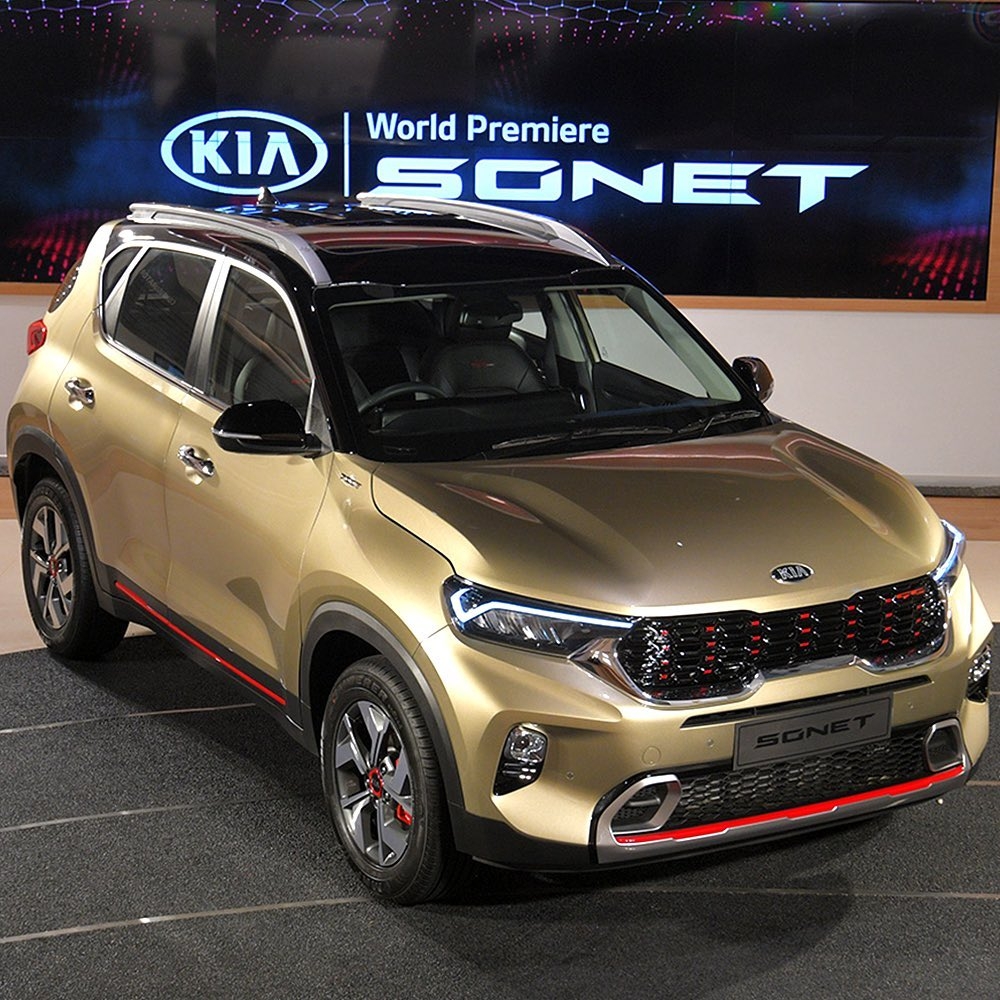
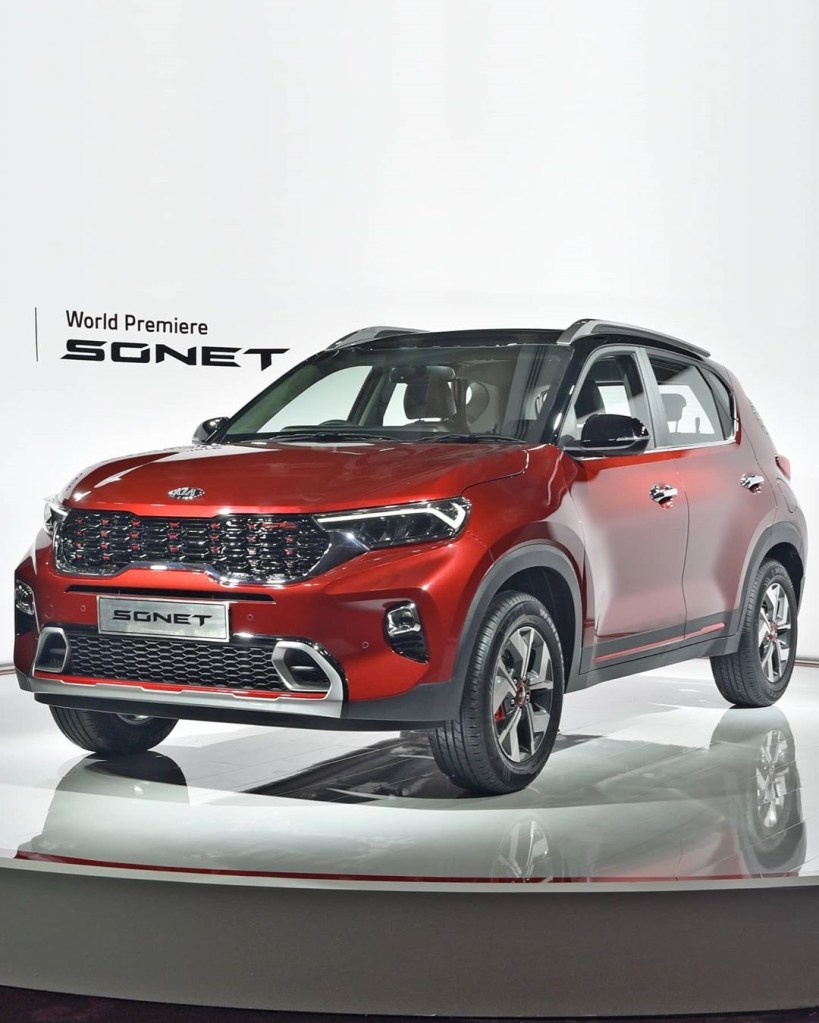
The all new subcompact SUV Kia Sonet #WildByDesign made its global debut in India.

Key Notes

  • Sonet will be available in two petrol and three diesel engines
  • Sonet will be available in two trims namely HT Line and GT Line
  • Bookings for Sonet commenced on 20th of last month

Kia Sonet was first showcased in Concept form in Auto Expo Delhi held in February this year. And production model resembles too close to that of the Concept version showcased earlier.

Design

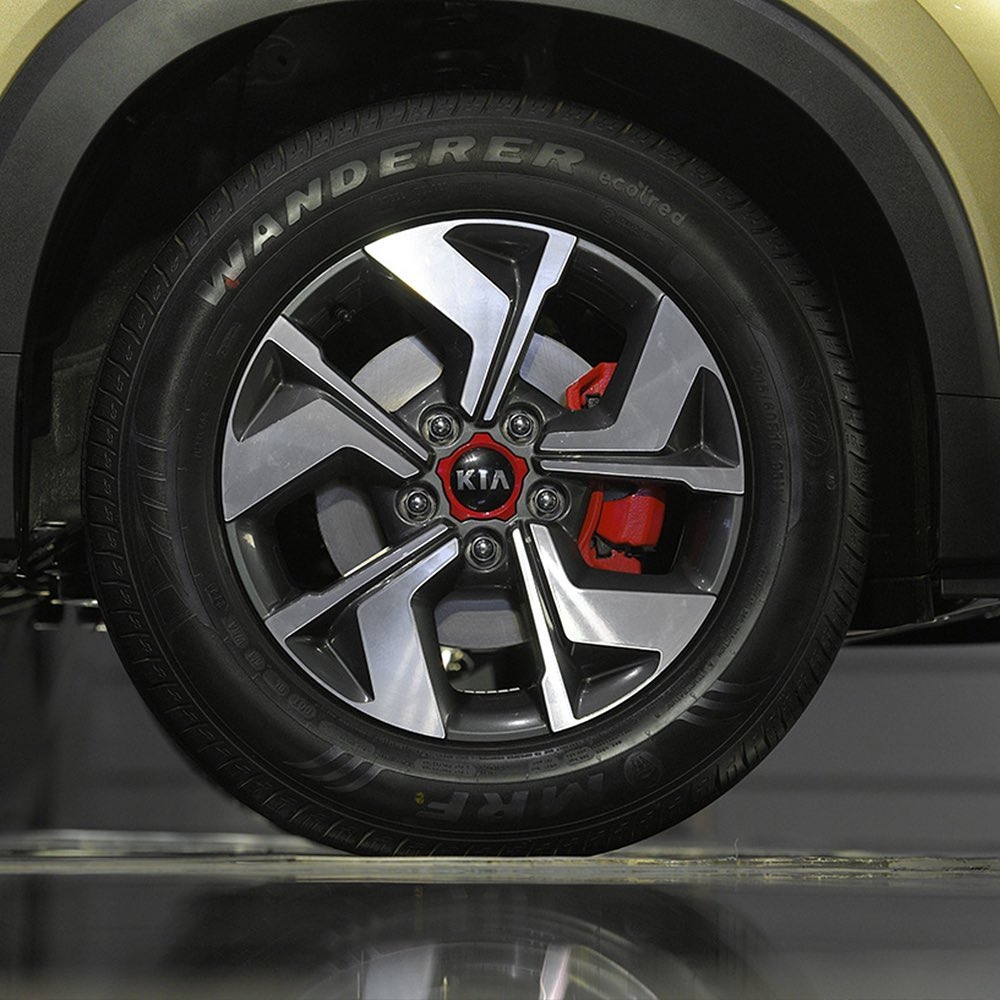
Kia Sonet is a sub-compact SUV which means it will sit below four meter category. Sonet has two trims – the GT Line and the Tech Line. Sonet seems to be muscular in design because of raised hood with scooped out musculature on the two sides. Sonet also gets large trademark Kia tiger nose front grille. Signature ‘heartbeat’ design daytime running lights give the car a modern look. LED headlamps and integrated LED DRLs, projector fog lamps, LED tail lights, front and rear faux skid plates, silver roof rails, 16-inch dual-tone alloy wheels and reflector garnish between the tail lights. The Kia Sonet GT Line will feature gloss black roof and ORVMs, red brake calipers at the front, gloss black grille with red accents.

The compact SUV is available in seven single-tone colours and three dual tone colour options. Kia Sonet will get its own new golden colour rest of the colours will be same that we have seen on the Seltos. 

Interiors

First thing you will notice as soon as you enter the car is 10.25-inch touchscreen which is largest in class and comes loaded with all the entertainment, Uvo connectivity features, Bose seven-speaker music system with sub-woofer.

The digital instrument cluster is smart, modern and different. It houses a 4.2-inch screen which gives lots of information such as turn-by-turn navigation, a trip computer, tyre pressure monitoring, drive mode to name a few.

There is a GT-Line badge on the steering and seats, and you also get red stitching and some red elements on the steering, seats, doors and dash. The GT-Line gets all-black treatment in interior.

While in Tech-Line you get two tone interiors. The Sonet also gets a sunroof at the top end, there are ventilated front seats, and an air purifier that comes with virus protection. 

Engine

Kia Sonet will be available with three engine options that include a 1.2-litre NA petrol, 1.5-litre diesel and a 1.0-litre turbo petrol. The 1.2-litre petrol engine will be paired only to a five-speed manual transmission while 1.5-litre diesel will be offered with a six-speed manual and six-speed torque converter automatic transmission. The 1.0-litre turbo-petrol engine will be available with an iMT and a seven speed DCT transmission.

Safety Features

In terms of safety, Sonet gets 6 airbags, ABS, hill assist, stability control, brake assist and ISOFIX anchors for child seats. Two-thirds of the chassis is made of high strength steel, making for a frame that is light and strong.

Once launched, Sonet will rival Hyundai Venue, Tata Nexon, Mahindra XUV 300, Maruti Suzuki Vitara Brezza, Ford EcoSport, Honda WRV and the upcoming Nissan Magnite and Toyota Urban Cruiser


Disclaimer- This blog is published by and reflects the personal views of the Carograaafy team, in their individual capacity.
Maruti Suzuki S-Cross Petrol Launched in India

  • Maruti Suzuki launched S-Cross petrol in India, prices starting at ₹8.39 lakh (ex-showroom).
  • S-Cross now gets BS6 compliant 1.5 litre K series petrol engine with mild hybrid technology.
  • S-Cross will be available with both Manual and Automatic Transmission option.
  • S-Cross can be booked through Nexa as well as online with token amount of ₹ 11000

S-Cross petrol was first showcased in Auto Expo 2020.

Engine Details

As Maruti Suzuki has discontinued giving Diesel engine option due to BS6 norms S-Cross now comes with 1.5 litre K-series petrol engine with mild hybrid SHVS technology with engine start-stop function which gives out 105Bhp power and 138Nm torque. The same engine also power’s Ciaz, Brezza, Ertiga and XL6. S-Cross is available with 5 speed Manual and 4 speed Automatic transmission option. Manual version gives out fuel economy of 18.55 kmpl while Automatic gives 18.43

Variants

S-Cross is available in four trims namely Sigma, Delta, Zeta and Alpha for Manual transmission while Automatic transmission is available only in Delta, Zeta and Alpha.

Features

In terms of features in 2020 S-Cross there are no major changes, except the introduction of the newer Smartplay Studio touchscreen infotainment system, with its slick interface.

S-Cross comes with standard safety equipment which includes dual Airbags, ABS, ISOFIX child seat mounts, rear parking sensors, front seatbelt reminders and a high-speed alert system, along with a hill hold assist function for the automatic variants. These safety features are standard across all variants and the S-Cross Petrol is also compliant with safety norms including frontal offset crash, side impact and pedestrian safety.

S-Cross Alpha variant comes equipped with features like LED projector headlamps and DRLs, 16-inch alloy wheels, leatherette upholstery, auto headlamps and wipers, keyless entry and go, a 7-inch touchscreen with Apple CarPlay and Android Auto, a rear-view camera and cruise control.   


Disclaimer- This blog is published by and reflects the personal views of the Carograaafy team, in their individual capacity

BREZZA vs NEXON vs VENUE vs ECOSPORT

Top end BS6 petrol manual models of compact SUV’s compared.

Engine and Transmission

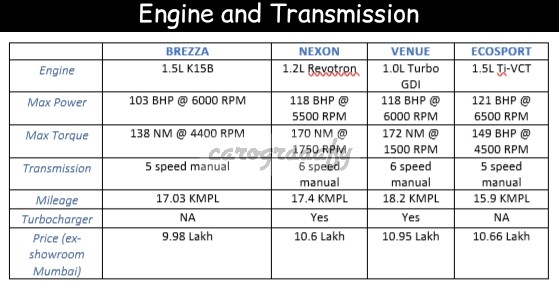
Brezza comes with 1.5L, 4 cylinders inline, 4 valve DOHC K15B engine which gives out 103 BHP power @ 6000 RPM and 138 NM torque @ 4000 RPM mated with 5 speed manual transmission.

Nexon comes with 1.2L Turbocharged Revotron engine, which gives out 118 BHP power @ 5500 RPM and 170 NM torque @ 1750 RPM mated with 6 speed manual transmission. Nexon comes with 3 driving modes namely Sports, City and Eco.

Venue comes with 1.0L Turbocharged engine, which gives out 118 BHP power @ 6000 RPM and 172 NM torque @ 1500 RPM mated with 6 speed manual transmission.

EcoSport comes with 1.5L Ti-VCT engine, which gives out 121 BHP power @ 6500 RPM and 149 NM torque @ 4500 RPM mated with 5 speed manual transmission. EcoSport being the most powerful among four compact SUV’s

Dimensions and Capacity

In terms of dimensions Nexon beats other three in most of the parameters. Nexon being wider than the other three having more shoulder room in second row which makes it easier to three people in it. Nexon is also heavier in the lot makes ride more stable.

Brakes and Tyres

Top end models of all four compact SUV’s comes with disc brakes in front and drum brakes in rear configuration. Nexon and Venue having lesser turning radius among four makes them easier to maneuver.

Safety Features

Venue and EcoSport comes with 6 airbags while other two come with 2 airbags. Tyre Pressure Monitoring System (TPMS) is available only in Nexon. ABS,BA and EBD is available in all four while Brezza misses out ESP and Hill Hold Control. Nexon has received highest 5 star adult safety rating by Global NCAP and 3 star rating for child occupants making it more safer among four.

Comfort and Features

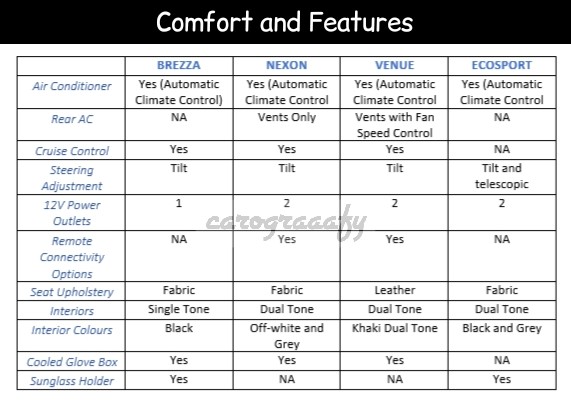
All four are having automatic climate control but rear AC vents are available only in Nexon and Venue. EcoSport misses cruise control while other three are having it. Venue comes with whole lot of connectivity options which can manage through an app on your mobile. Geo fencing, Remote car lock-unlock, find my car to name a few. Nexon also comes with few connectivity options while Brezza and EcoSport misses them

Exterior

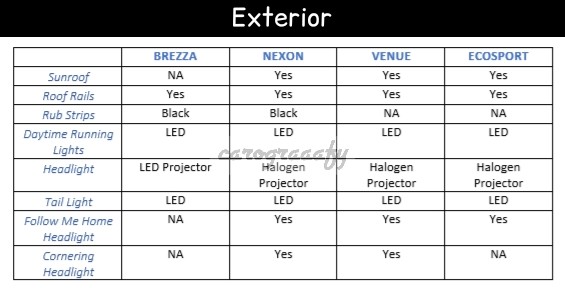
Except Brezza other three comes with electronic sunroof. Brezza comes with LED Projector headlamps while other three are having Halogen Projector headlamps. We personally like exterior styling of Nexon more. In comparison to other three Nexon looks bigger and better.

Dashboard and Instrument Cluster

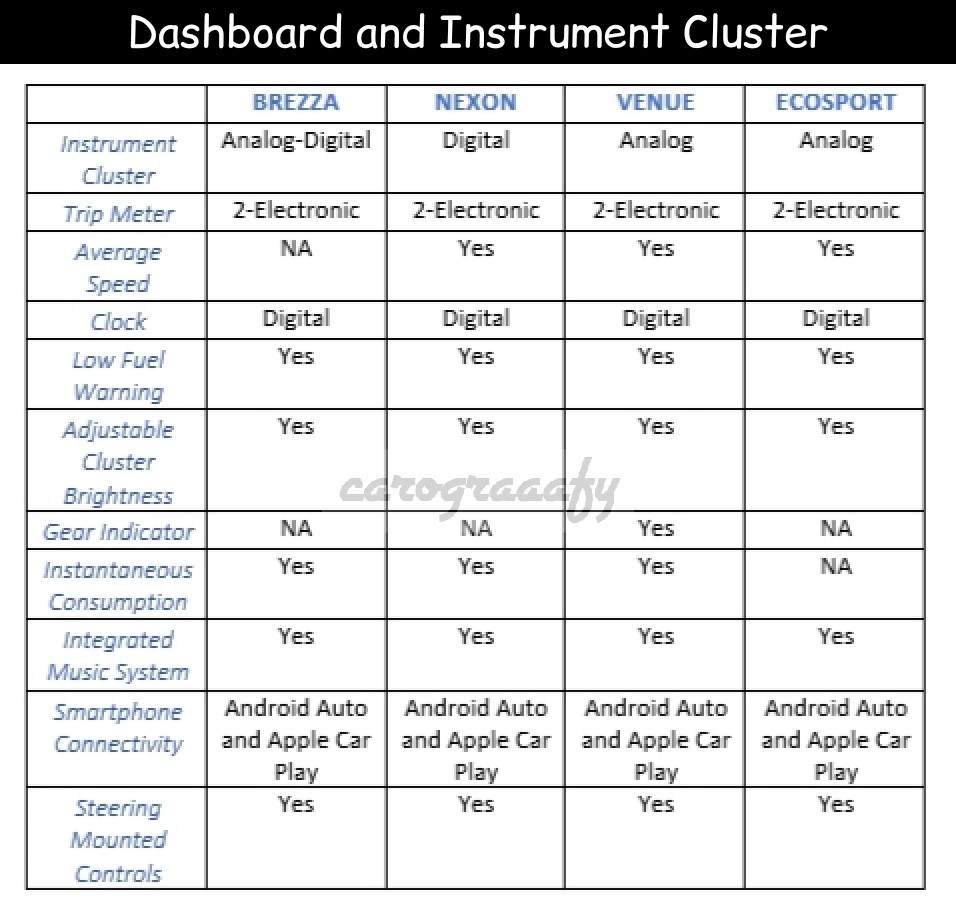
Nexon comes with fully Digital instrument cluster, Brezza comes with analog-digital one and Venue and EcoSport are having analog one. All four are having features such as Android Auto and Apple Car Play smartphone connectivity, GPS navigation, USB and AUX compatibility features in common to be name a few. While Venue’s cabin is more driver friendly among other three.

Final Verdict

If you want hassle free and pocket friendly after sales service then go for Brezza, Nexon for superior build quality, Venue for more connectivity options.


Disclaimer- This blog is published by and reflects the personal views of the Carograaafy team, in their individual capacity.

Hyundai Venue iMT launched in India

2020 Hyundai Venue intelligent Manual Transmission(iMT) prices start from Rs 9.99 lakh


Venue also gets new Sport trim for turbo petrol and diesel models.

Hyundai India has launched the iMT gearbox in the Venue, with prices starting at Rs 9.99 lakh (ex-showroom). The iMT variant is available only with the 1.0-litre turbo-petrol engine across four trims, including SX, SX (O), SX Sport and SX (O) Sport.

The intelligent Manual transmission or iMT is essentially a six-speed manual transmission that features an electromechanically actuated clutch. The iMT technology features a Transmission Gear Shift (TGS) lever with intention sensor, hydraulic actuator and Transmission Control Unit (TCU). Hyundai Venue iMT is offered only with a 1.0-litre turbocharged petrol engine producing 118bhp and 172Nm of torque.

The iMT is different from the AMT gearboxes already offered by numerous manufacturers in India. An iMT does away with the clutch like in an AMT, but the driver still needs to manually change gears. The idea is to provide both, the engagement of a manual and the convenience of an automatic. The upcoming Kia Sonet, closely related to the Venue will also get an iMT option.

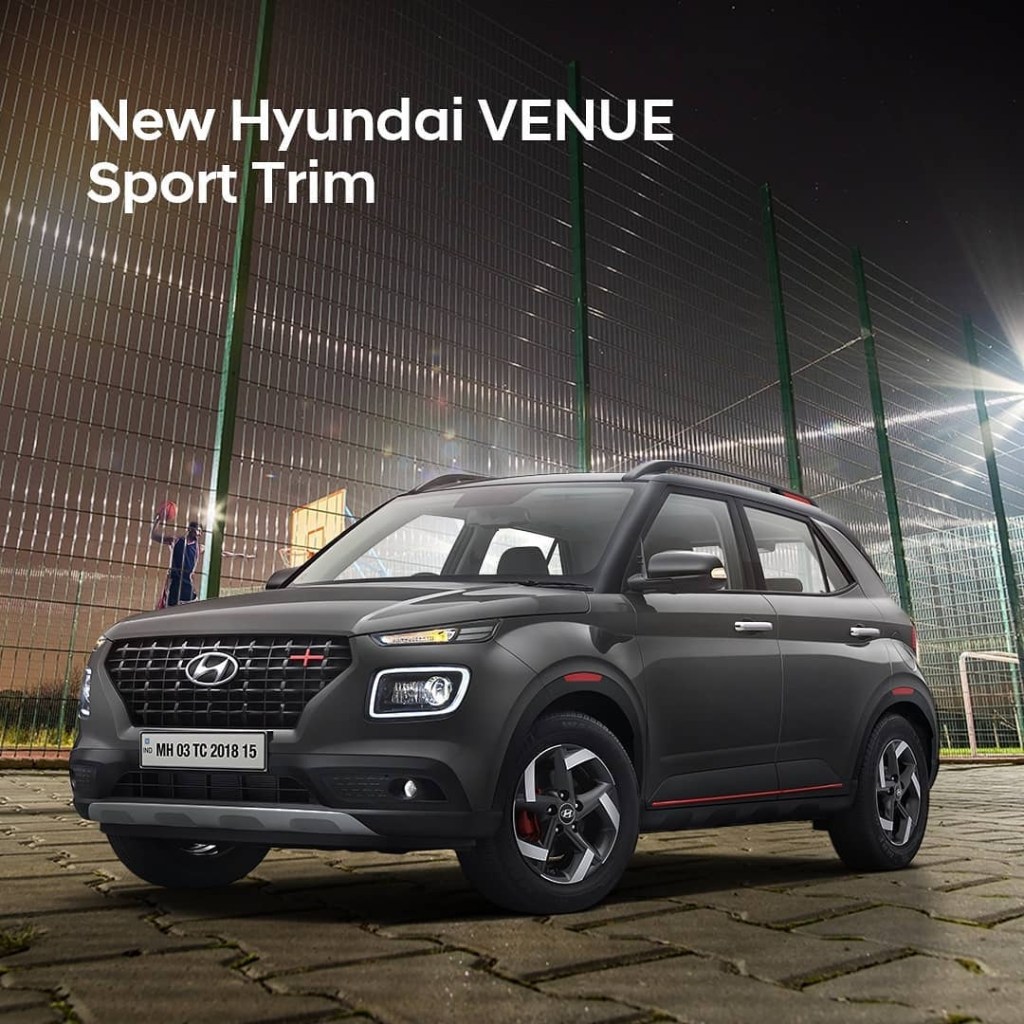
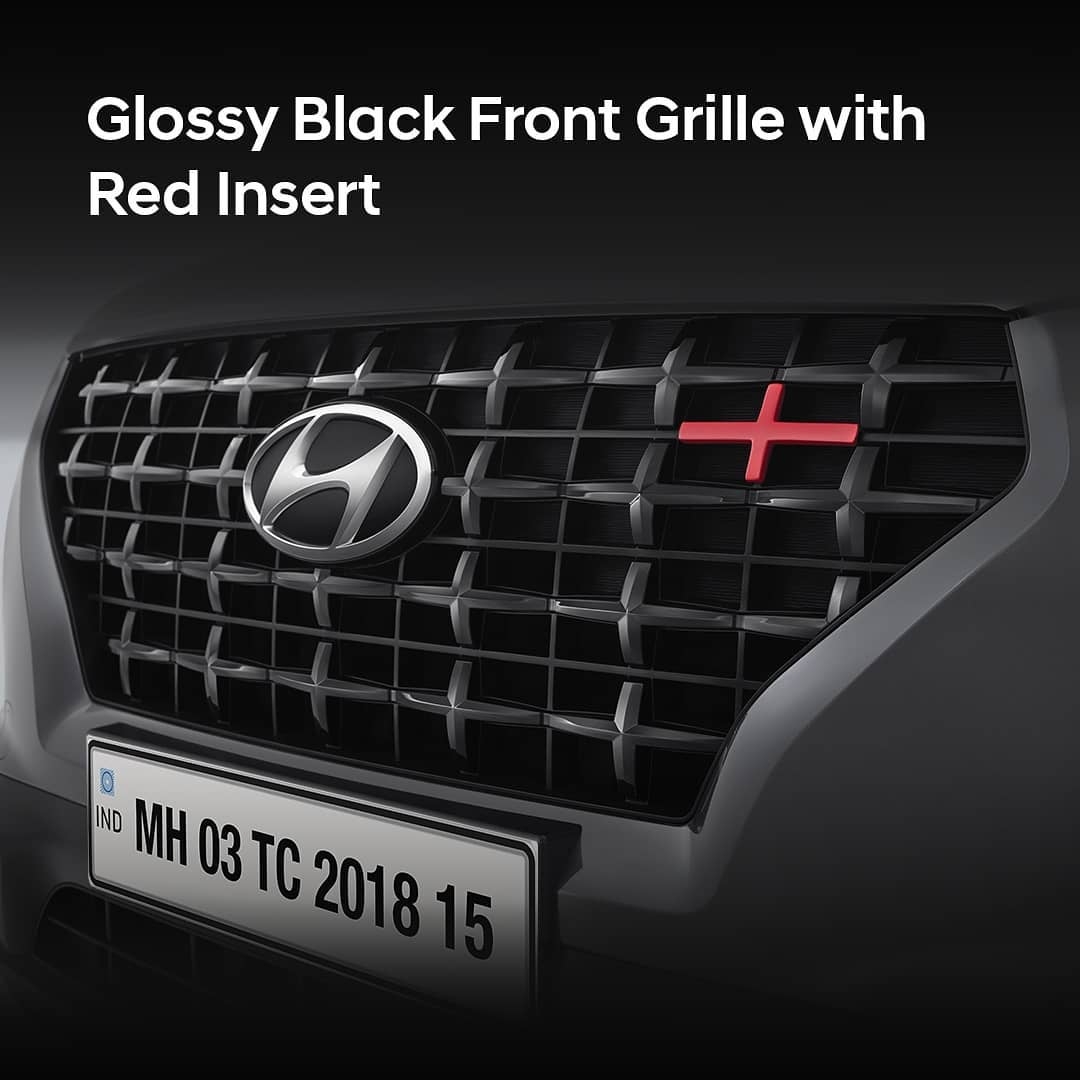
Venue iMT, will also be available in the Sport trim, features a new dual-tone paint of Titan Grey with Phantom Black roof, paddle shifters, Red brake calipers, Gloss Black grille with Red insert, Dark Grey roof rail with Red insert, Red inserts on wheel arches and body side moulding, flat-bottom steering wheel, Dark Grey upholstery and contrast Red stitching. The venue Sport trim is also available with the 1.5-litre diesel engine.